In a carry-on, cologne is allowed in containers of 3.4 ounces / 100 milliliters or less, inside one quart-sized bag along with your other liquids. In checked baggage you can take much more, but not unlimited: the FAA caps alcohol-based toiletries at 2 kg / 2 L (70 oz / 68 fl oz) total per person, with no single container over 0.5 kg / 500 ml. Those two sentences cover almost every question people have.
Carry-on: the 100 ml rule, applied to fragrance
TSA's liquids rule is the familiar one: items must be "3.4 ounces (100 milliliters) or less per item", carried in "a quart-sized bag of liquids, aerosols, gels, creams and pastes", one bag per passenger. Anything larger goes in checked baggage — TSA's own instruction is to "pack items that are in containers larger than 3.4 ounces or 100 milliliters in checked baggage." TSA's guidance for perfume specifically restates the same limit: less than or equal to 3.4 oz / 100 ml allowed.
Three consequences that catch people out. A 100 ml bottle is fine— it is exactly at the limit, and the most common full-size men's bottle size. A 200 ml or 6.8 oz bottle is not, even if it is nearly empty, because the rule is about container capacity rather than contents. And the bottle has to fit inside the quart bag alongside your toothpaste and sunscreen, which is the real constraint on a week's trip with more than one fragrance.
If your fragrance is an aerosol rather than a pump spray, TSA also requires that "permitted aerosol release devices (button/nozzle) must be protected by caps or other suitable means to prevent accidental release" — in practice, keep the cap on.
Checked baggage: the limit nobody mentions
Most people assume checked bags are unrestricted for toiletries. They are not, because cologne is an alcohol-based product and therefore falls under the FAA's hazardous-materials provisions for medicinal and toiletry articles. The limits, as TSA states them for perfume: "the total aggregate quantity per person cannot exceed 2 kg (70 ounces) or 2 L (68 fluid ounces)", and "the capacity of each container must not exceed 0.5 kg (18 ounces) or 500 ml (17 fluid ounces)".
For a normal traveller this is a non-issue — 68 fluid ounces is roughly twenty 100 ml bottles. It becomes a real issue in exactly one situation, which is worth flagging because it is common: buying fragrance abroad, or moving a collection. If you are checking a bag with fifteen bottles in it, you are closer to the line than you think, and it applies per person rather than per bag.
Two practical notes on checked bottles. Cabin pressure changes and baggage handling are hard on glass, so a sprayer that leaks costs you the fragrance and everything packed around it — wrap bottles and put them inside a sealed bag. And heat is the real enemy: a bag that sits on a runway in summer gets hot enough to degrade fragrance, which our shelf-life guide explains in more detail. If a bottle matters to you, it should be in the cabin.
Duty free, and the bag they seal it in
Fragrance bought after security can exceed 100 ml because it never passes through a liquids checkpoint on that leg. The complication is connecting flights: if you clear security again at a transfer airport, the oversized bottle has to be in a sealed tamper-evident bag with the receipt visible, or it can be confiscated. Keep the sealed bag sealed until you are at your destination, and if the itinerary involves re-clearing security in another country, check that country's rules rather than assuming the US ones apply.
The last rule, which is not a legal one
Do not apply fragrance on the plane. A cabin is a small, enclosed, recirculated space with several hundred people in it, some of whom are genuinely sensitive to fragrance, and it is the single most reliable way to annoy people who cannot move away from you. Spray before you leave for the airport, or after you land. The same reasoning applies to the amount: one spray, and our spray-count guide covers why enclosed spaces need fewer.
What to look for in a travel format
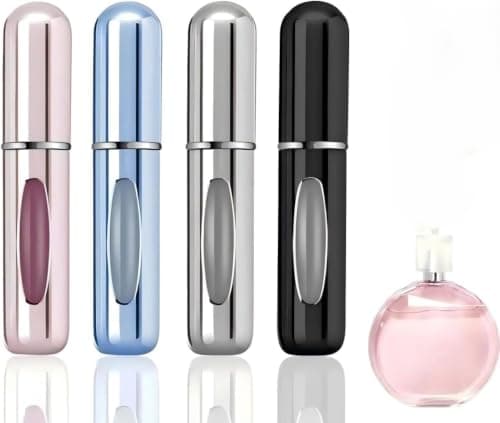
Three specs. Capacity at or under 100 ml, which is the only hard requirement. A sealing mechanism you trust — screw-top atomizers and manufacturer travel sprays hold pressure; cheap push-fit lids leak, and a leaked bottle in a quart bag ruins the whole bag. And enough capacity for the actual trip: a 5 ml atomizer holds roughly fifty sprays, which is a fortnight at two a day, so the common mistake is taking too little rather than too much.
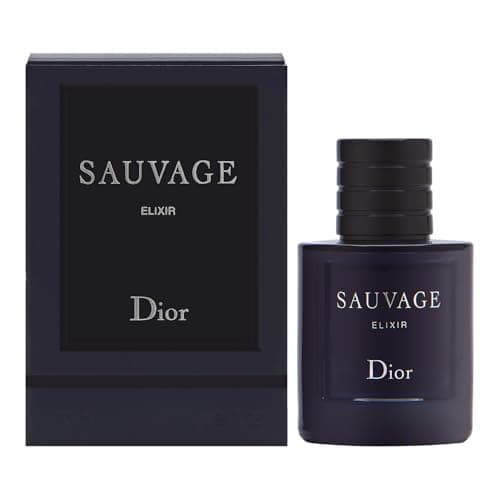
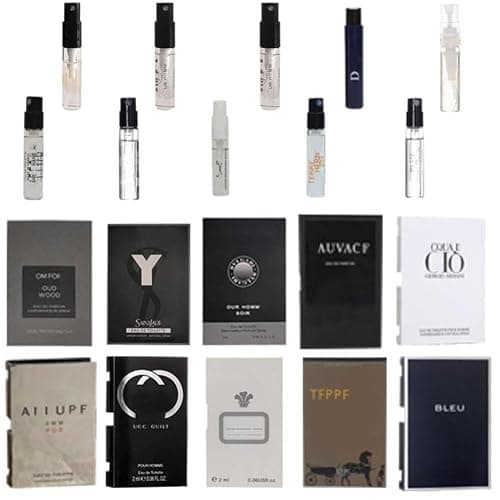
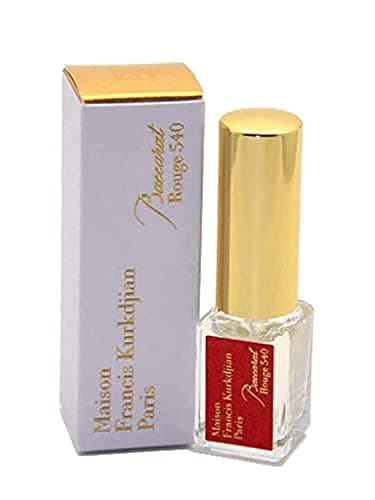
On format, refillable atomizers are the cheapest answer by a wide margin because they let you carry what you already own rather than buying a second bottle of it. Manufacturer minis and travel refills cost more but come sealed, pre-filled and unambiguous at a security check. Vial sets are the best option for a long trip where you want options without weight. All four below are carry-on legal as sold.
Packing fragrance properly
Decant before you fly, not at the airport
Filling an atomizer takes five minutes at home and is genuinely awkward in a terminal. Fill it the night before, label it — unlabeled clear liquid in a bag invites questions — and put it in the quart bag rather than loose in your rucksack. The mechanics of transferring fragrance between bottles are in fragrance decants.
Take one fragrance, not four
Trip length does not multiply the number of fragrances you need; it multiplies the volume of one. A single versatile bottle covers a week far better than four narrow ones, and it keeps the quart bag usable. If you want one bottle that works in any climate and any occasion, that is exactly what our main ranking optimizes for, and how many colognes you need makes the broader case for restraint.
Match the fragrance to where you are going, not where you live
The heavy amber that works at home in February is the wrong bottle for a humid week somewhere tropical — heat amplifies and thickens exactly the fragrances that need cold to read well. Pack for the destination's weather. Our summer and winter rankings are the quick way to pick the right end of your own collection.
Travel sizes you buy versus travel sizes you fill
A four-pack of refillable atomizers costs about the price of a coffee and works with every bottle you own — that is the default answer. Buy a manufacturer mini or travel refill instead when you want to try an expensive fragrance on the trip anyway, or when you would rather not explain a decanted liquid at a border. There is more on the trade-off in travel-size cologne.